How to Pass Your Family History to the Next Generation
Names and dates are just the start. Here's how to capture and pass on the family history that actually matters — stories, photos, and context.

Your grandchildren won't remember your grandparents.
That sounds obvious, but think about what it actually means. The people you know — the stories you've heard, the faces you recognize in old photos — will be completely unknown to the generation two or three steps below you. Unless someone does something about it.
That someone is probably you.
What's Actually Worth Passing On #
Most people start with names and dates. Birth years, marriage records, a family tree diagram. That's the skeleton — necessary, but not what makes a family history come alive.
What future generations will actually care about:
Stories. Not just "he was born in 1902" but what was he like? What did he do for work? What was hard about his life? What did he find funny? Stories are the thing that turns a name on a tree into a person.
Photos with context. A photo without names and dates is almost worthless to future generations. A photo labeled "Grandmother at her bakery, Munich, 1958" is irreplaceable. The labeling matters as much as the image itself.
Documents. Birth certificates, letters, immigration papers, recipes, anything handwritten. The originals are fragile — scan them now, at high resolution, before they deteriorate further.
Sources. Where did you find this information? A source citation now saves your grandchildren hours of re-research if they ever want to dig deeper.
The People Problem #
Here's the urgent part: some of what you want to preserve only exists in living memory.
The older relatives in your family carry knowledge that isn't written down anywhere. Once they're gone, that knowledge is gone. This is the one part of family history preservation that has a real deadline.
You don't need a formal interview. A voice memo on your phone during a family dinner. A few questions at a holiday. "What do you remember about your parents?" "What was it like growing up there?" Even rough, informal recordings capture something that nothing else can.
Don't wait for the right moment. There isn't one — there's just the time you have now.
Making It Accessible to the Next Generation #
Preserving family history and making it accessible are two different problems.
A well-organized folder on a hard drive that nobody knows about solves the first problem and completely ignores the second. Future generations need to know it exists, be able to find it, and have the tools to open it.
A few things that help:
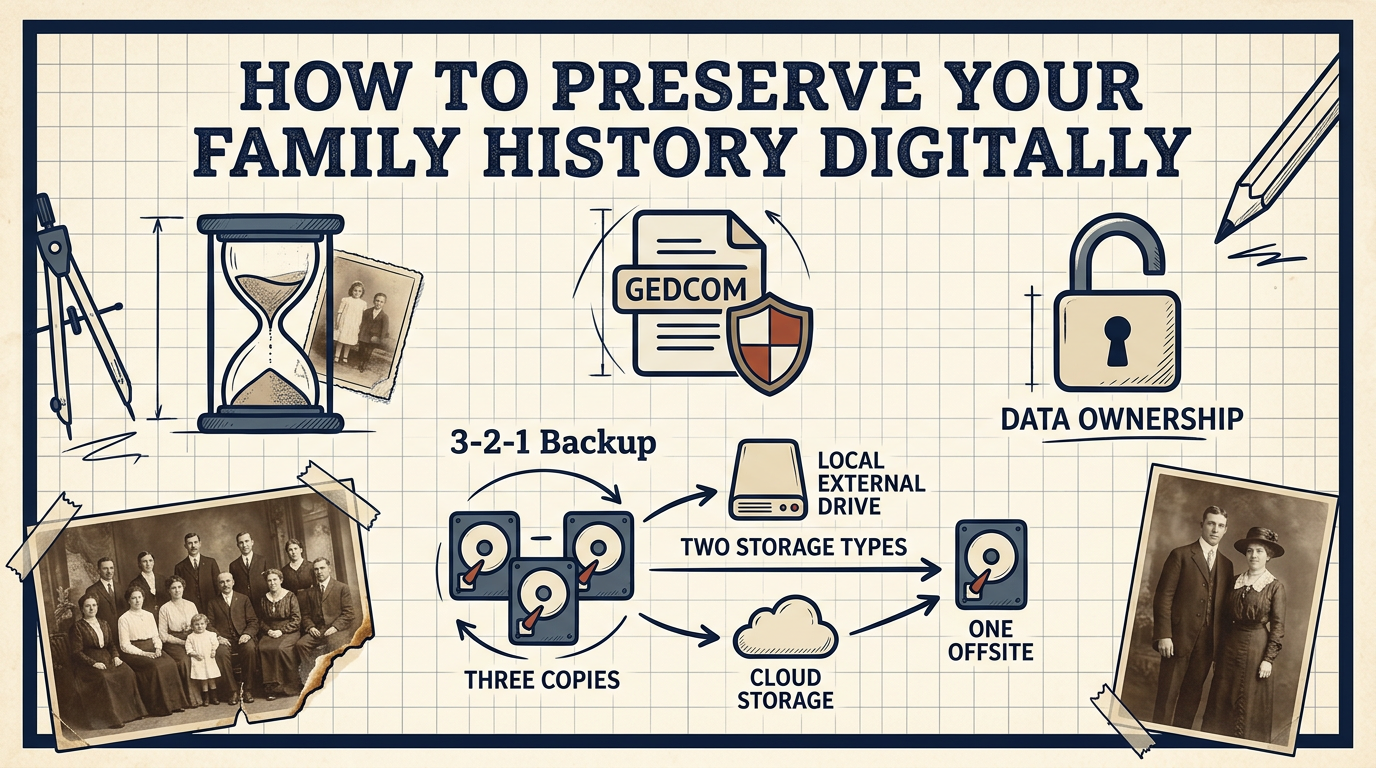
Use open formats. GEDCOM for family tree data, JPEG or TIFF for photos, PDF for documents. These formats are readable without specialized software and are likely to remain so for decades.
Store in multiple places. At least one copy should be somewhere a family member can access without depending on you — a shared drive, a physical backup at a relative's home, or a platform that supports data export.
Write a simple guide. One page explaining what you've collected, where it lives, and how to access it. Leave it somewhere obvious.
Start before it's complete. A half-finished family history that's accessible and backed up is worth more than a perfect one that only you can find.
If you want a secure, private home for everything you collect, famstory is built for exactly this — a place to store your family's story without making it public or losing control over who sees it. Learn more about creating a family tree online or preserving your family history.
FAQ #
How do I start collecting family history? #
Start with what you already know — your own family, living relatives, and any documents you have at home. Work outwards from there. Interviewing older relatives first is the most time-sensitive part.
What format should I use to store family history for children? #
Use open, widely supported formats: GEDCOM for genealogy data, JPEG or TIFF for photos (300 dpi minimum), and PDF for scanned documents. Avoid proprietary formats tied to specific software.
How do I make sure my children can access family history after I'm gone? #
Leave clear written instructions — where data is stored, what formats are used, and how to access any accounts or files. Store at least one copy in a location they can physically access. See also: What Happens to Your Family Tree When You're Gone?