What Happens to Your Family Tree When You're Gone?
Most people never plan for this. Here's what happens to your genealogy data after you die — and how to make sure it survives.
Nobody talks about this. But it's worth thinking about.
You've spent years building your family tree. Researching names, tracking down documents, writing down stories that only a few people still remember. It's a real body of work.
What happens to it when you're gone?
For most people, the honest answer is: they don't know. And the platforms most people use don't make it easy to find out.
What Happens to Platform Accounts After Death #
Most genealogy platforms tie your data to your account. When you die, what happens depends on the platform's policies — and those policies are often buried in terms of service.
A few common scenarios:
The account gets locked. Without login credentials, family members may not be able to access the data at all. Even with credentials, most platforms prohibit sharing account access in their terms.
The account eventually gets deleted. Inactive accounts are sometimes removed after a period of inactivity, or when a subscription lapses. If nobody keeps the subscription active, the data disappears.
The data can be exported — if someone knows how. Most platforms support some form of data export, but the person who needs to do it has to know the account exists, know the login details, and do it before access is lost.
None of this is designed to be hostile. But it means that the default outcome — doing nothing, assuming it will work out — often results in data loss.
For context on how platforms actually own and control your data, see Who Owns Your Family Tree Data?.
The Platform Lock-In Problem #
There's a deeper issue beyond account access.
When your family history lives inside a platform's proprietary system, it can only be read through that platform's tools. If the platform shuts down, gets acquired, or changes its export policies, that data may become inaccessible in any practical sense — even if technically it still exists somewhere.
This has happened before with genealogy services. Platforms have shut down, merged, or significantly changed their offerings. Users discovered too late that their data wasn't as portable as they assumed.
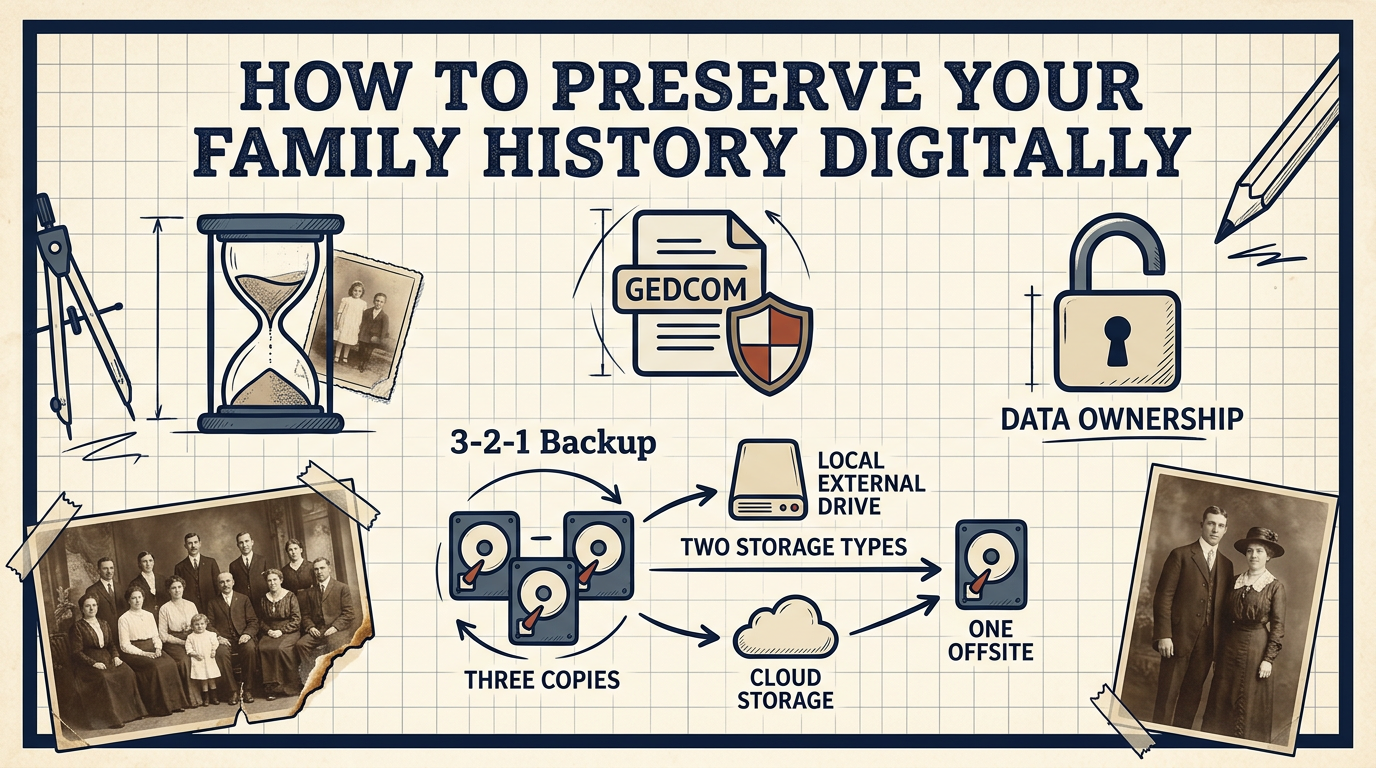
The only real protection against this is keeping your data in open, exportable formats — and not relying on any single platform as the sole home for your family history. See How to Preserve Your Family History Digitally for what that looks like in practice.
What You Can Do Now #
A few concrete steps that don't require much time:
Export your data regularly. Most platforms support GEDCOM export. Do this once a year at minimum and keep the file somewhere safe — ideally in more than one place.
Document where your data lives. Leave a clear note — physical or digital — that tells a trusted family member: here's what I've built, here's where it is, here's how to access it. This doesn't need to be complicated. A single page with account names, what's stored where, and any export files is enough.
Choose platforms that support data portability. If you're picking a tool now, the ability to export your data at any time in a standard format should be a baseline requirement. It's the difference between your family history being yours versus being rented.
Consider your storage beyond the platform. A local copy of your family data — GEDCOM files, scanned documents, photos — stored somewhere your family can access is a form of insurance that no platform policy can take away.
famstory is built around the idea that your family history should always be yours — with full data export and no lock-in. Learn more about end-to-end encrypted family tree storage that keeps your data under your control.
FAQ #
Can family members access my Ancestry account after I die? #
Ancestry has a legacy contact and account removal process, but it's not automatic. Without prior planning, family members may not be able to access or export your data.
How do I make sure my family tree survives after I'm gone? #
Export your data regularly in GEDCOM format, store it in multiple places, and leave clear instructions for a trusted family member on where everything is and how to access it.
What is the best format to leave genealogy data for future generations? #
GEDCOM is the standard open format for genealogy data. Combined with scanned documents in PDF and photos in JPEG or TIFF, it gives future generations the best chance of accessing your work regardless of what tools exist at the time.