Are Genealogy Websites Safe? A Privacy Guide
Are genealogy websites safe? Learn how your data is stored, who can access it, and how to protect your family tree online.
You want to build your family tree, explore your roots, and maybe even connect with distant relatives.
But before you upload names, dates, and photos, one important question comes up:
Can you actually trust genealogy websites with your data?
Most platforms promise security and privacy—but those two things are not the same. A website can be technically secure while still exposing your data in ways you didn’t expect.
In this guide, we’ll break down how genealogy websites handle your data, what risks exist, and how to choose a safer option.
What Data Do Genealogy Websites Collect? #
When you build a family tree online, you’re often sharing more than you realize.
Most genealogy platforms collect:
- Names of family members
- Birthdates and locations
- Relationships between individuals
- Photos and documents
Some platforms also offer:
- DNA testing data
- Historical records and matches
- User-generated notes and stories
While this information helps build richer family trees, it also creates a detailed dataset about real people—especially when living relatives are included.
Who Can Access Your Data? #
One of the biggest concerns is not just what data is collected—but who can actually see it.
Depending on the platform, access may include:
Other users #
- People researching similar family lines
- Suggested matches or connections
- Users requesting access to your tree
Public visibility #
- Public trees can be viewed by anyone
- Some data may appear in search engines
Platform systems #
- Algorithms analyze your data to suggest matches
- Internal systems process and store your information
Even if your tree is set to private, parts of your data may still be discoverable depending on the platform’s design.
If you're unsure how visibility works in detail, see Is Your Family Tree Public?.
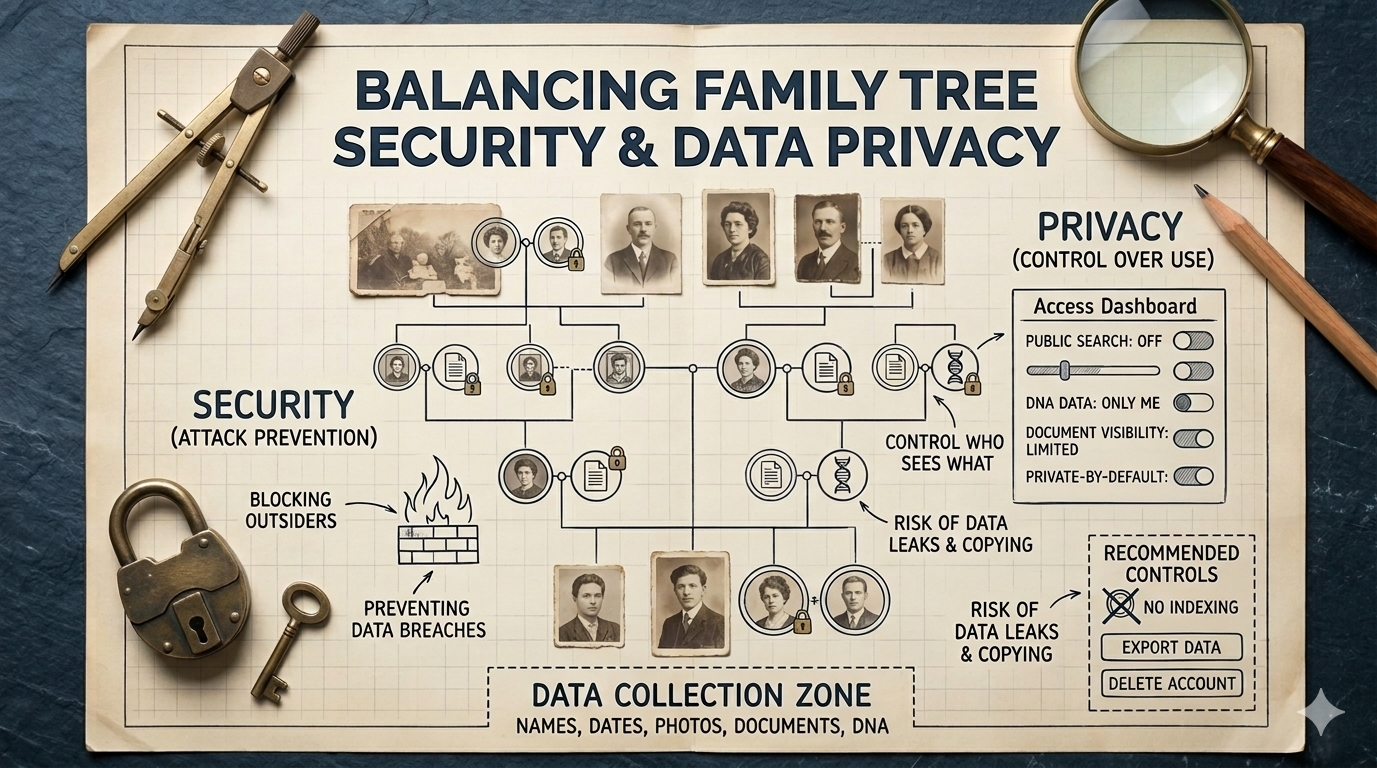
Security vs Privacy #
These two terms are often used interchangeably—but they mean very different things.
Security #
Refers to how well your data is protected from external threats:
- Encryption
- Secure servers
- Protection against hackers
Privacy #
Refers to how your data is used and shared:
- Who can see your information
- Whether your data is indexed or discoverable
- How much control you have over access
A platform can be secure but not private.
For example:
- Your data may be encrypted (secure)
- But still visible to other users or searchable (not private)
Understanding this difference is key when evaluating genealogy websites.
Data Breach Risks #
Like any online service, genealogy websites are not immune to data breaches.
While major platforms invest heavily in security, risks still exist:
- Large databases are attractive targets for attackers
- Personal and historical data can be exposed
- Even partial leaks can reveal sensitive information
Beyond technical breaches, there are also practical risks:
- Accidental sharing
- Misconfigured privacy settings
- Data copied by other users
This is why minimizing exposure and choosing the right platform matters.
Choosing a Safe Platform #
If you want to protect your family data, look for platforms that prioritize both security and privacy.
Key features to look for:
- Private-by-default trees
- No public indexing
- Clear and simple privacy controls
- Full control over who can access your data
- Ability to export and delete your information
Platforms like famstory focus on giving you a secure and private environment for your family history—without the complexity of managing visibility across multiple layers.
If you're still evaluating how public your data might be, start here:
👉 Is Your Family Tree Public?
And if you want practical steps to protect your data:
👉 How to Keep Your Family Tree Private Online
Conclusion #
Genealogy websites can be powerful tools—but they come with trade-offs.
Your data might be secure from hackers, yet still visible to other users. Or it might be private in theory, but difficult to fully control in practice.
The key is understanding:
- What data you’re sharing
- Who can access it
- How much control you really have
With the right approach—and the right platform—you can enjoy building your family tree without compromising privacy.
If you want a single private place for your research, famstory keeps your tree private with no social sharing. Learn more about creating a family tree online or preserving your family history securely.
Ready to begin? Start your family tree with famstory today!
FAQ #
Are my ancestors’ details safe? #
Historical data is generally less sensitive, but when combined with modern information and living relatives, it can still create privacy concerns.
Can my data be hacked? #
While most platforms use strong security measures, no system is completely risk-free. That’s why limiting exposure is important.
Are DNA results public? #
DNA data is usually not public by default, but it may be used for matching and research depending on the platform’s policies. Always review the settings carefully.