Is there a blueprint for genealogy?
I asked myself if there is some kind if pattern for genealogy, since I felt lost in research. I asked reddit and got a lot of helpful comments.
Is there a blueprint for genealogy research I asked myself? #
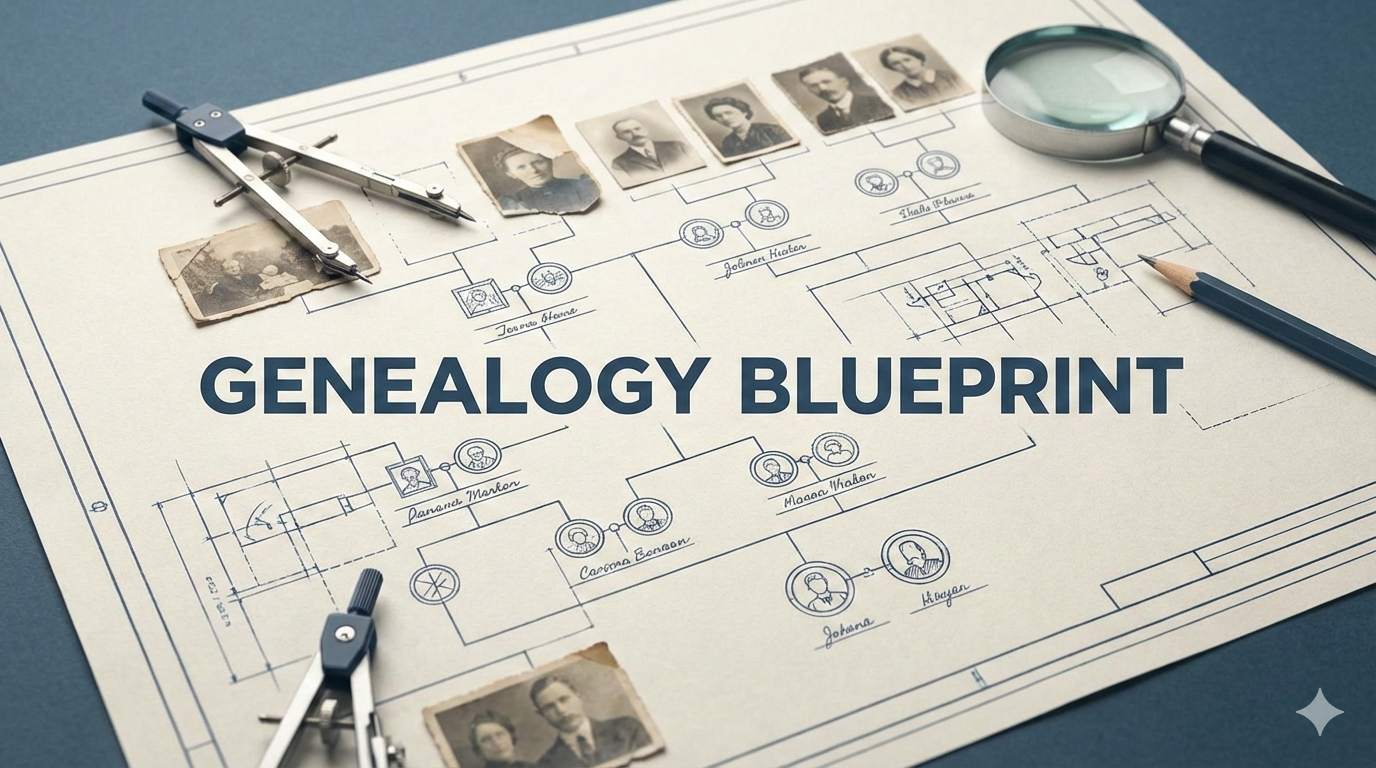
Since I am still a beginner in genealogy I felt some kind of lost when searching with a lot of open ends. I gathered all information my living family still holds and now I started to search a gazillion person on Google, familySearch and so on. So coming from a tech background, I asked myself is there some kind of blueprint or pattern I could reuse for every person I am researching? If you're just starting out, check out our guide on genealogy for beginners to get started simply and privately. I found some useful information online, on comogen.net, but was still not satisfied, so I asked the reddit community.
What did the community say? #
Lots of people said there isn’t one universal blueprint, most say: you get a feel for it over time. Several pointed out that for the first year or two it’s often “shoot from the hip” until you know which records exist for your regions and families. A few patterns came up again and again.
Start with one clear question. For example: who was this person? If it’s a married woman on a census, you need her maiden name, so the next step is usually her marriage record. From there you can look for her birth record, then siblings and the parents’ marriage. Many researchers aim to find birth, marriage, and death for each person, plus children’s births and any census or immigration records. One tip that came up: if someone has a very common name, search for a sibling with an uncommon name to tell people apart.
Location changes the game. In places with regular censuses, tracking someone through census years first often gives you a framework. Who they lived with, work, birth year, parents’ birthplaces, immigration year, and so on. That makes it easier to then look for specific vital or immigration records. For 19th-century Ireland or German-speaking areas, the first thing to nail down is place. Without a place, it’s hard to get far, so tools like MeyersGaz or gov.genealogy.net for historic places can help.
Use others’ trees as clues, not truth. Several people said they look at FamilySearch, Ancestry, WikiTree, or similar to see what’s already been done and which primary sources are attached, but never copy a tree. A tree is not a source. Then they search the actual records (census, vital records, immigration, probate, newspapers for obits and marriage notices) and attach a source or screenshot to every fact.
Clean up and then search. One piece of advice that stuck: if you use FamilySearch, take time to clean up a profile (remove wrong or unsupported data, merge duplicates). The search algorithm often works better on a clean profile. And research doesn't always move in a straight line. Someone described it as "spiraling up in overlapping circles": you come back to the same records with new context and notice things you missed. But if you are privacy focused a FamilySearch public profile is propably not for you. I would not do that. For a privacy-focused alternative, consider private family tree software that keeps your data secure and away from public databases.
Have a research plan and a log. Especially coming from a tech background, treating it like a project helps: start with what you know (names, dates, places) and work backwards. Decide what you want to learn, then list which sources could answer that. Keep a log of what you searched, where, and what you found (or didn't). Documenting "I looked here and didn't find X" is also useful. Some use genealogy software to track this; others use AI to suggest a search order based on their question and what's available. If you need to view existing GEDCOM files, our free GEDCOM viewer can help you visualize your family tree data.
Learn from the region and time period. When stuck, searching YouTube or the web for the specific time and place (e.g. “1880s New Orleans”, “German church records”) often turns up strategies and record sets you didn’t know about. Channels like AncestryAimee and Amy Johnson Crow were recommended for methodology.
A simple pattern you can adapt #
- One person or couple at a time, with a clear research question so you don’t wander down every rabbit hole.
- Extract everything from each record before moving on (e.g. from a census, add all family members and details, not just the one person).
- Standard set of goals per person: birth, marriage, death, children’s births, censuses; add immigration, newspapers, probate if relevant.
- Adjust by place: census-heavy countries → build a census framework first; Germany / Ireland → lock down the place, then church or civil offices.
- Source everything and note when you looked but didn’t find something.
Conclusion #
So is there a blueprint? Not a single one, but there are repeatable habits: one clear question, a standard set of records to aim for, location-specific order of search, and good housekeeping (sources, clean profiles, research log). Having a loose pattern and then adapting it when something doesn't work helped me a lot. If you're building your own tree and want to keep it private and in one place, famstory lets you do that with no social sharing. Learn more about creating a family tree online or preserving your family history securely.
Ready to begin? Start your family tree with famstory today!
Thanks a again to Reddit-Community, for this valuable Discussion!