Genealogy Without DNA Testing: Build Your Tree Privately
You don't need a DNA test to build a real family tree. Here's how to do deep genealogy with records, archives, and living memory — privately.
Somewhere along the way, DNA testing started to feel like the front door to genealogy. Order a kit, spit in a tube, and your family history unlocks itself.
It doesn't work like that.
A DNA test tells you roughly who you're related to. It doesn't tell you their names, their lives, or their stories. For that — for actual genealogy — you still need records, and the memories of the people around you.
The good news is that all of it is possible without ever mailing off a sample. Genealogy was a deep, serious discipline for a century before at-home DNA existed. It still is.
DNA Is an Add-On, Not the Foundation #
Here's the order that got reversed in a lot of people's minds.
A genome gives you probabilities and matches — a cousin you didn't know about, a percentage from a region. That can be a useful clue. But it's a clue that only becomes a story once you go and find the documents behind it.
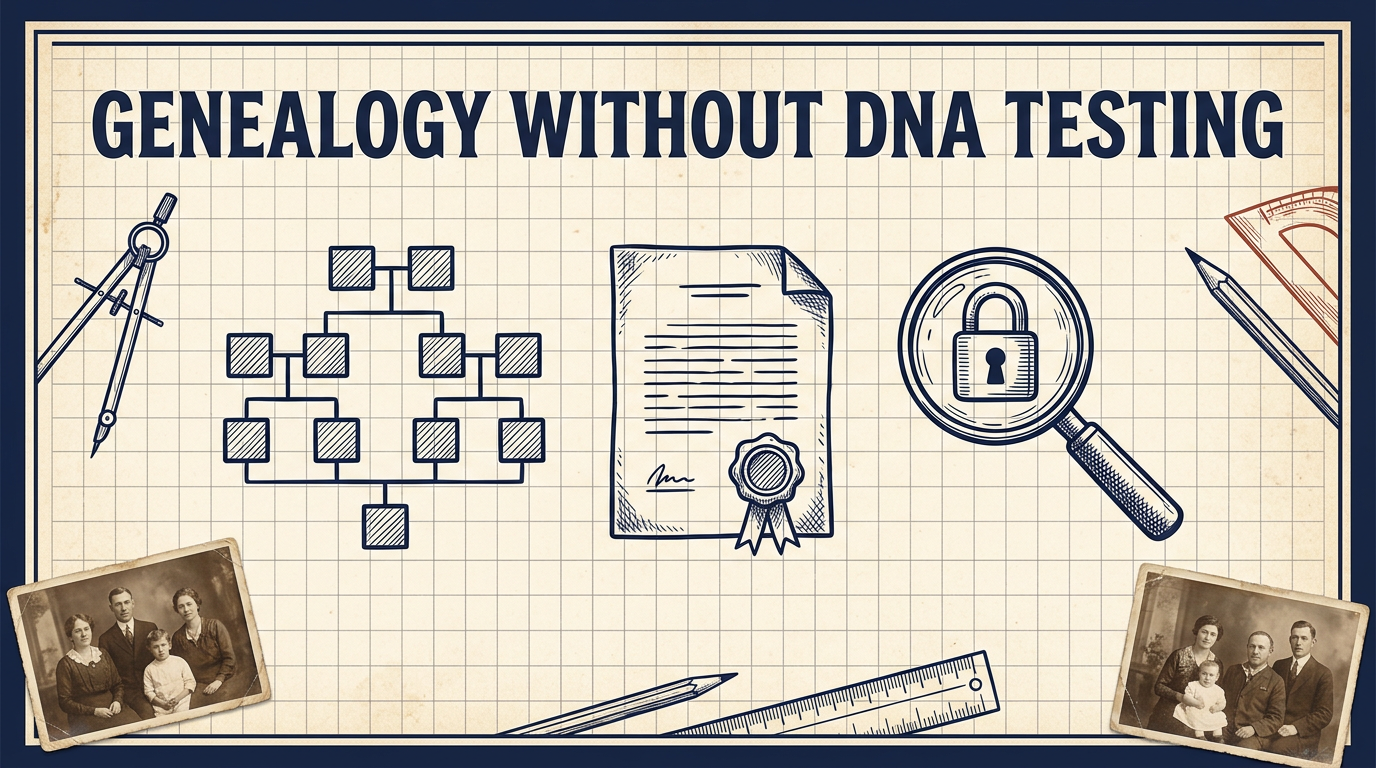
The foundation of genealogy is the paper trail, not the genome. Birth, marriage, and death records. Census returns. Church books and parish registers. Immigration and naturalization files. Probate, wills, and land records. Newspapers for obituaries and marriage notices. This is the material that gives you names, dates, places, and relationships you can actually prove.
If you want the repeatable method behind all of this, we walked through it in our genealogy blueprint — one clear question at a time, a standard set of records to aim for, and a source attached to every fact. None of it needs a test kit.
Start With the Living, Then Work Backward #
Before you touch an archive, talk to your family.
Living relatives hold the things no database has: maiden names, the village a grandparent actually came from, the reason the family changed its name at a border, the photo with names written on the back. These interviews are the single richest source most beginners overlook — and they have a deadline that records don't.
From there you work backward, one person or couple at a time. You know a name, a date, a place; you use it to find the next record, which gives you the next name, and the chain grows. This is the same "spiral up in overlapping circles" that experienced researchers describe. It's slow in the best way, and every step is something you can verify.
The Records Are More Open Than You Think #
You don't need a genome to reach them, either.
Enormous amounts of genealogical material are free and public: national archives, FamilySearch's record collections, civil registration offices, digitized church books, and gazetteers that help you pin down historic place names. For many regions, the hard part isn't access — it's locking down the exact place so you know which parish or office to search. Once you have that, the records open up.
DNA can occasionally break a wall down — an unknown parent, an adoption. But for the overwhelming majority of a family tree, patient record work gets you further, and it never exposes your genome or your relatives' to anyone.
Give That Research a Private Home #
Here's where it matters what you do with everything you find.
If you spend years assembling names, dates, documents, and photos, that archive is precious — and it doesn't belong on a public profile or inside someone else's matching network. The whole point of doing genealogy without DNA is to keep your family's history under your control. It would be strange to hand it away at the storage step.
That's the idea behind private family tree software: end-to-end encrypted, private by default, no public profiles, no social sharing, and no genome to leak — because there's no genome involved at all. famstory is built around exactly that. (To be clear: famstory doesn't offer DNA tests. It's the private place your research lives.) You can create your family tree online and keep it that way from the first name onward.
You don't need to give up your DNA to know where you come from. The records were always the real story — and they can stay entirely yours.
FAQ #
Can you do genealogy without a DNA test? #
Yes. Records, census returns, church books, immigration files, documents, and interviews with living relatives are the actual foundation of family history. DNA is an optional add-on, not a requirement.
Is DNA-free genealogy less accurate? #
No — in most cases it's more precise. Documents give you verifiable names, dates, and relationships, while DNA gives you probabilities and matches that still need records to interpret. DNA mainly helps with specific walls like unknown parentage.
Where do I start if I don't want to test my DNA? #
Start with living relatives, then work backward through vital records, censuses, and church books, one person at a time. Keep your growing tree in private, encrypted family tree software so the research stays yours.